


Increased Demand for Biomethanol Drives Innovation of New Technologies…
Converting wood biomass into biomethanol is a complex yet promising pathway for producing renewable fuel from abundant, non-food lignocellulosic resources. The process integrates advanced thermochemical and catalytic technologies, and recent innovations such as plasma arc gasification are pushing the boundaries of efficiency and feedstock flexibility. This expanded overview explores the full conversion chain, from raw wood to refined methanol, with a focus on how plasma arc technology enhances the gasification stage.
The journey begins with the fundamental challenge of breaking down wood biomass, which is composed of cellulose, hemicellulose, and lignin; tough, fibrous polymers that resist decomposition. Traditional gasification methods rely on high-temperature environments (typically 1,500 – 2,200°F) and limited oxygen to convert this solid biomass into synthesis gas, or syngas, a mixture of carbon monoxide (CO), hydrogen (H₂), carbon dioxide (CO₂), and trace gases. This syngas becomes the building block for methanol synthesis. However, conventional gasifiers such as fixed-bed, fluidized-bed, and entrained-flow systems, each come with trade-offs in terms of tar formation, feedstock preparation, and scalability.
Enter plasma arc gasification, a cutting-edge alternative that uses electrically generated plasma to achieve extremely high temperatures, often exceeding 3,000°C. In this environment, wood biomass is not merely combusted or oxidized but rather broken down at the molecular level into its elemental components. Plasma is created by passing an electric current through a gas (often air, steam, or argon), forming an ionized, high-energy state capable of vaporizing virtually any organic material. This results in a cleaner, more uniform syngas with significantly reduced tar and char content compared to traditional gasification methods.
One of the key advantages of plasma arc gasification is its ability to handle heterogeneous or contaminated feedstocks, including wood waste with high moisture or ash content. Because the plasma torch provides intense, localized heat, it can process feedstock without the need for extensive drying or size reduction. This flexibility is particularly valuable in decentralized or small-scale applications where feedstock consistency is difficult to maintain. Moreover, the high temperatures ensure nearly complete carbon conversion, with carbon conversion efficiencies reported as high as 97% in experimental setups.
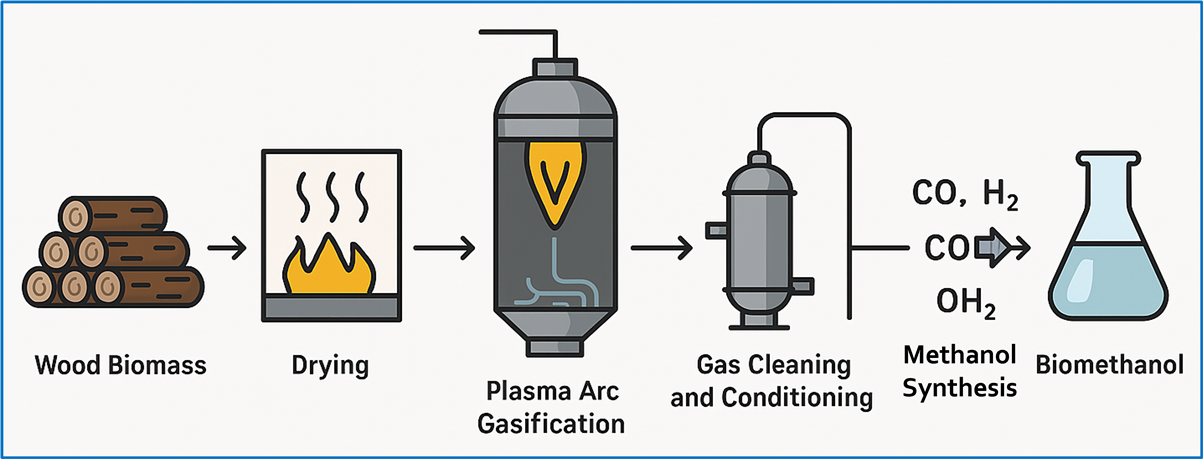
Syngas Cleaning and Conditioning: Ensuring Catalyst Integrity
Once the wood biomass is gasified, whether through conventional or plasma-based methods—the resulting syngas must be cleaned and conditioned. Raw syngas contains impurities such as particulates, tars, sulfur compounds (like hydrogen sulfide), nitrogen compounds (such as ammonia), and halides. These contaminants can poison the catalysts used in methanol synthesis and must be removed through a series of steps. Cyclones and filters remove particulates, while scrubbers and tar reformers eliminate condensable hydrocarbons. Desulfurization units, often using zinc oxide or activated carbon, trap sulfur compounds. In some systems, a water-gas shift reactor is used to adjust the H₂/CO ratio to the optimal 2:1 for methanol production.
Plasma gasification offers a distinct advantage here as well. Because it produces a cleaner syngas with fewer tars and particulates, the downstream cleaning requirements are reduced. This not only lowers operational costs but also extends the life of catalysts and reduces the frequency of maintenance shutdowns. Additionally, the high-temperature environment vitrifies inorganic residues into a stable, non-leachable slag, minimizing solid waste and environmental impact.
Methanol Synthesis: Catalytic Conversion and Reactor Efficiency
With the syngas cleaned and conditioned, it is ready for methanol synthesis. This step involves catalytically converting CO and H₂ into methanol (CH₃OH) under high pressure (typically 50–100 bar) and moderate temperatures (200–300°C). The reactions are exothermic and require precise control to maximize yield and selectivity:
- CO + 2H₂ → CH₃OH
- CO₂ + 3H₂ → CH₃OH + H₂O
Copper-based catalysts, typically composed of Cu/ZnO/Al₂O₃, are widely used due to their high activity and selectivity. Reactor design plays a crucial role in efficiency. Fixed-bed reactors are common, but loop reactors with internal heat exchangers are increasingly favored for their ability to recover heat and improve conversion rates. Companies like Johnson Matthey have developed advanced methanol synthesis loops that integrate seamlessly with renewable hydrogen inputs, further enhancing sustainability.
The Role of Green Hydrogen in Enhancing Sustainability
Speaking of hydrogen, one of the most promising developments in biomethanol production is the integration of green hydrogen, produced via electrolysis using renewable electricity. By supplementing the hydrogen content of syngas, green hydrogen allows for more complete utilization of CO and CO₂, increasing methanol yield and reducing carbon intensity. This hybrid approach not only improves process economics but also aligns with net-zero goals by enabling carbon recycling within the system.
Feedstock Variability and Process Optimization Strategies
Process optimization is essential throughout the entire chain. Wood biomass is inherently variable in moisture, ash content, and energy density, which can affect gasification performance. Preprocessing steps such as drying, chipping, or pelletizing help standardize the feedstock. In plasma systems, feedstock preparation requirements are less stringent, but consistent feeding and torch control remain critical. Real-time monitoring and digital process control systems are increasingly used to manage these variables, ensuring stable operation and high efficiency.
Heat Integration and Energy Recovery Opportunities
Heat integration is another area of focus. The exothermic nature of methanol synthesis and the high temperatures of gasification offer opportunities for energy recovery. Captured heat can be used to preheat feedstock, generate steam, or power auxiliary systems, improving overall energy efficiency. In plasma systems, part of the electricity used to generate plasma can be offset by utilizing the produced syngas in combined heat and power (CHP) systems. Studies have shown that up to 33% of the electricity required for plasma formation can be recovered in this way.
Environmental and Economic Benefits of Biomethanol
From an environmental perspective, producing biomethanol from wood biomass offers several compelling benefits. It is considered carbon-neutral because the CO₂ released during combustion or use is offset by the CO₂ absorbed during the growth of the biomass. It also diverts forestry residues and wood waste from landfills or open burning, reducing methane emissions and air pollution. Moreover, by decentralizing fuel production and utilizing local biomass resources, it enhances energy security and supports rural economies.
Barriers to Commercialization and the Importance of Policy Support
However, challenges remain. Plasma arc systems, while efficient and flexible, are capital-intensive and require robust electrical infrastructure. Feedstock logistics and sourcing, transporting, and storing biomass can be complex and costly, particularly in remote areas. Policy support in the form of carbon pricing, renewable fuel standards, and investment incentives is critical to making these projects economically viable.
Emerging Market Applications: Shipping and Beyond
Despite these hurdles, the future of biomethanol from wood biomass looks promising. In the maritime sector, biomethanol is gaining traction as a low-emission fuel compatible with existing engine technologies. It can also be blended with gasoline or used in biodiesel production, offering a drop-in solution for decarbonizing transport. As a platform chemical, it serves as a precursor for formaldehyde, acetic acid, and other industrial products, expanding its market potential.
Conclusion: Plasma Gasification as a Catalyst for Renewable Fuel Transition
In conclusion, the integration of plasma arc technology into the gasification process represents a significant advancement in the production of biomethanol from wood biomass. By enabling cleaner syngas production, reducing feedstock constraints, and improving overall efficiency, plasma systems enhance the viability of this renewable fuel pathway. As technology matures and climate policies tighten, biomethanol is poised to play a central role in the global transition to sustainable energy.